Blood, Land & Revolution: The Untold Story of the Fideicomiso & Mexico’s Foreign Property Laws
How a pastry chef, a million dead revolutionaries, and Hollywood elites accidentally created the world’s most misunderstood real estate system
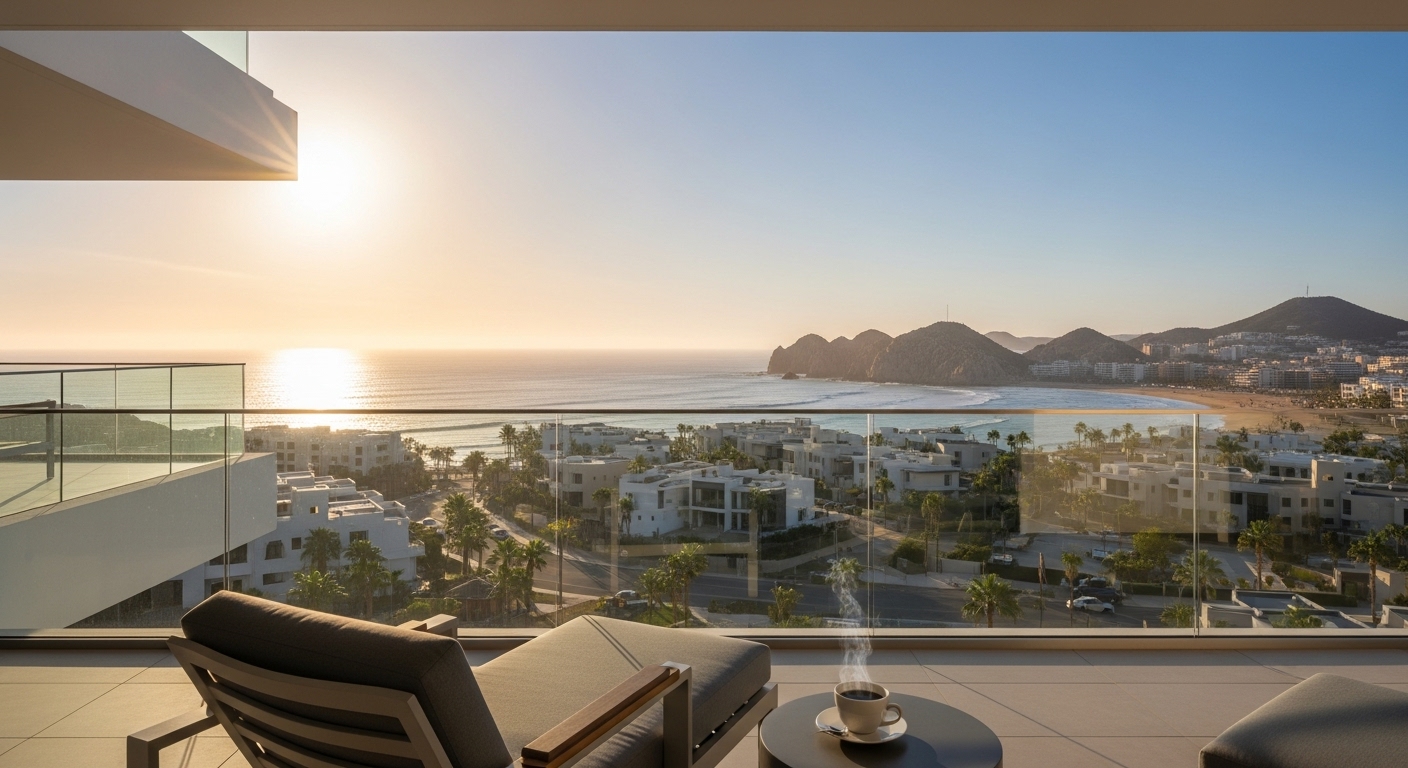
Imagine sipping a margarita on your beachfront terrace in Los Cabos, watching the sunset paint the Sea of Cortez in brilliant oranges and purples. Life is good. Your property is worth millions. But here’s what’ll blow your mind…
The reason you can legally own that slice of paradise has absolutely nothing to do with modern real estate law. It has everything to do with a French pastry chef who got his bakery trashed in 1838, a revolution that killed over a million people, and one of the most brilliant legal workarounds in history, now known as the fideicomiso.
Buckle up, because this story is about to get wild…
When Foreigners Owned Everything (And Mexicans Owned Nothing)
Let’s rewind to 1517. Hernán Cortés and his conquistadors didn’t just “discover” Mexico – they stole it. And I mean everything. Land, gold, people, the works.
For the next 300 years, Mexican soil belonged to Spanish overlords while indigenous people became strangers in their own homeland. Think that sounds dramatic? It gets worse.
Even after Mexico kicked out the Spanish in 1822 and declared independence, the land stayed in foreign hands.
Enter Porfirio Díaz, Mexico’s president for 30 years (1876-1911). This guy was so obsessed with foreign investment that Mexicans started joking he was literally selling their country piece by piece to international buyers. American railroad barons owned vast stretches of northern Mexico. European investors controlled the mines. The Catholic Church hoarded massive estates.
Meanwhile, 95% of rural Mexicans owned exactly zero land.
You know that feeling when you’re priced out of your own neighborhood? Imagine that, but for an entire country. For 400 years.
The pressure was building. And when it finally exploded…
The Pastry War That Sparked a Revolution
Before we get to the million-death revolution, let me tell you about the most ridiculous international incident in history. Because this little story explains everything about why Mexico got so paranoid about foreign property rights.
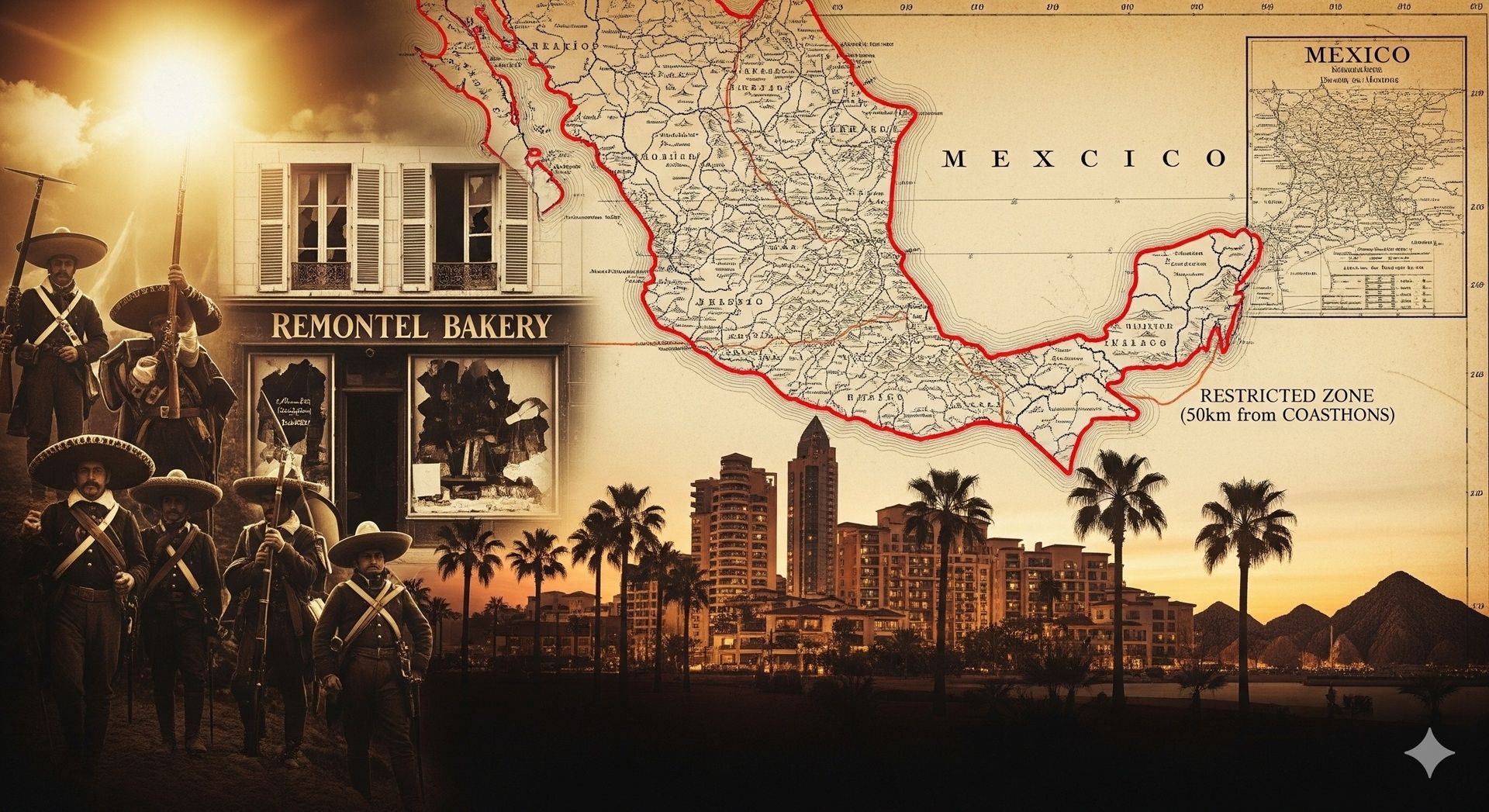
The year was 1838, Mexico City. A French pastry chef named Remontel owned a bakery. During some local political chaos, Mexican soldiers trashed his shop. Remontel wanted compensation. Mexico said “tough luck.”
So what does France do?
They send warships.
I’m not kidding. The French Navy blockaded Mexican ports and bombarded Veracruz until Mexico agreed to pay for the damn pastries. They called it “La Guerra de los Pasteles” – The Pastry War.
A pastry chef got his home government to use military force against a sovereign nation over property damage.
This wasn’t isolated. Throughout the 1800s, European powers and the United States repeatedly used gunboat diplomacy to protect their citizens’ property claims in Latin America. Got a business dispute? Call in the navy!
Mexican leaders watched this pattern and thought: “Never again.”
They were about to write that promise in blood.
“Tierra y Libertad!” – The Revolution That Shook the World
By 1910, the powder keg finally exploded.
Emiliano Zapata, a peasant leader from the south, rallied his followers with a simple battle cry: “¡Tierra y Libertad!” – Land and Liberty! His army wasn’t fighting for abstract political ideals. They wanted their ancestral lands back.
And they were willing to die for it.
What followed was 10 years of the bloodiest civil war in the Western Hemisphere. Over one million people died – roughly 1 out of every 15 Mexicans. Entire villages were wiped out. Families destroyed. The country was literally torn apart.
But here’s the thing that’ll give you chills: They kept fighting. For a decade. Because the land meant everything.
Visualize Zapata’s peasant armies, many barefoot and armed with machetes, facing down federal troops equipped with modern weapons. They fought because they believed – no, they knew – that Mexico belonged to Mexicans.
When the smoke finally cleared in 1920, the survivors faced a choice: How do you make sure this never happens again?
Their answer became Article 27 of the new Constitution. And it was radical.
Article 27: The Constitutional Bombshell That Rewrote Mexican Property Law Forever
February 5, 1917. The Constitutional Convention in Querétaro was about to drop the most revolutionary property law in modern history.
Article 27 completely redefined land ownership:
“Ownership of the lands and waters within the boundaries of the national territory is vested originally in the Nation.”
Read that again. The Nation owns everything. Private property became simply the government allowing you to use land. And they could take it back anytime they wanted for the “public good.”
But wait, it gets better (or worse, depending on your perspective).
The same article created the “Restricted Zone” – a band of territory where foreigners were absolutely prohibited from owning land:
- 100 kilometers (62 miles) from any international border
- 50 kilometers (31 miles) from any coastline
Look at a map of Mexico. You know what’s in those zones? Every single beach resort you’ve ever heard of. Cancún, Puerto Vallarta, Playa del Carmen, and yes – Los Cabos.
The message was crystal clear: “We fought and died to get this land back from foreigners. We’re not giving it away again.”
And just to make sure no foreign government could pull another “Pastry War,” they included the Calvo Clause. Any foreigner who wanted to do business in Mexico had to agree to settle all disputes in Mexican courts and never ask their home government for help.
No more gunboat diplomacy. Ever.
The Unintended Economic Consequences
The revolutionaries got what they wanted. By 1988, the government had created over 28,000 ejidos – cooperative farms where peasants could work the land collectively.
Mission accomplished, right?
Well… not exactly.
See, the ejido system had a tiny problem: It was economic suicide.
The land belonged to the federal government. Ejido members could use it, but they couldn’t sell it, mortgage it, or lease it to outsiders. Want to expand your farm? Too bad – no bank will lend money against land they can’t foreclose on. Want to partner with someone who has capital? Nope – outsiders can’t own ejido land.
Imagine being given a Ferrari with no engine.
By the 1970s, Mexico was facing a brutal reality: They had the most beautiful coastlines in North America, but they were broke. Tourism was exploding worldwide, but Mexico couldn’t attract the foreign investment needed to build world-class resorts.
The reason was simple: Every single prime beach was in the Restricted Zone.
The government faced an impossible choice: Abandon the constitutional principles that a million people died for, or watch other countries get rich off tourism while Mexico stayed poor.
And then someone had a brilliant idea…
The Billion-Dollar Brainstorm That Saved Mexico’s Economy
The scene: 1970, Mexico City. President Luis Echeverría is staring at a massive problem.
His country just went through a debt crisis. The economy is tanking. But he’s got something every tourist-hungry American and European dreams about: 3,000 miles of pristine coastline.
There’s just one tiny problem: The Constitution says foreigners can’t own it.
Echeverría’s team starts thinking outside the box. What if they could let foreigners control beachfront property without technically owning it?
Enter the masterminds: A group of forward-thinking notaries and businessmen who saw the massive potential of Mexico’s coasts. They’d been studying an obscure 1926 law about bank trusts – something called a “fideicomiso.”
The idea was elegant in its simplicity:
- A Mexican bank holds legal title to the property
- The foreign buyer becomes the “beneficiary” of a trust
- The beneficiary gets all the rights of ownership – they can live there, rent it, sell it, even pass it to their heirs
- But on paper, a Mexican institution owns it
Constitutional crisis solved. Foreign investment unlocked. Revolutionary principles preserved.
In 1973, this became official law as part of the new Foreign Investment Act.
But here’s where the story gets really interesting…
The Los Cabos Experiment: From Fishing Village to Paradise
While Mexico City lawyers were crafting legal frameworks, something magical was already happening in Los Cabos.
Los Cabos in 1970 was basically nowhere. A dusty fishing village where the desert meets the sea. No roads, no airport, no hotels. Just a few hundred locals making a living from the ocean.
But Hollywood had discovered it.
In 1956, Abelardo “Rod” Rodriguez Jr., son of a former Mexican president, and his wife Lucille Bremer—a former actress and singer who shared the screen with Fred Astaire—built the Hotel Palmilla, an ultra-exclusive resort accessible only by private plane or yacht. Bing Crosby flew in regularly. Lucille Ball was a frequent guest. John Wayne loved the fishing. The hotel would eventually become the iconic and exclusive One&Only Palmilla.
These weren’t your typical tourists. These were rich tourists. The kind who didn’t care about legal technicalities – they just wanted paradise, and they were willing to pay for it.
The Mexican government was watching. And learning.
In 1967, they fed data into a computer (this was cutting-edge stuff back then) to identify the best locations for tourism development. The computer spit out three names: Cancún, Ixtapa, and Los Cabos.
The government created FONATUR – the National Fund for Tourism Development – with a simple mission: Turn these remote locations into world-class destinations.
But first, they needed infrastructure.
Building the Foundation for Foreign Investment
Here’s where the story gets really wild.
The Mexican government basically said: “We’re going to build roads and airports to the middle of nowhere, and then we’re going to invite the world to come build hotels.”
In 1973, they completed the Transpeninsular Highway – 1,000 miles of road connecting Tijuana to Cabo San Lucas. Suddenly, you could drive to Los Cabos instead of flying or sailing.
In 1977, they opened Los Cabos International Airport. Now you could fly direct from major U.S. cities to what had been an isolated fishing village just a few years earlier.
The fideicomiso law had just been passed. For the first time in Mexican history, foreigners could legally and securely own property in the coastal zone.
Everything aligned perfectly. The infrastructure was ready. The legal framework was solid. The government’s infrastructure investment was just the beginning.
All they needed was someone brave enough to bet big on a desert peninsula at the edge of nowhere.
The Mexican Real Estate Gold Rush Begins
What happened next was like the California Gold Rush, but with margaritas.
International hotel chains that had been eyeing Mexico’s coasts for years suddenly had the legal security they needed to invest. Hilton, Westin, Marriott – they all started breaking ground.
But the boom extended far beyond hotels. Wealthy Americans and Canadians, tired of crowded California beaches and expensive Hawaii real estate, discovered they could own oceanfront property in paradise for a fraction of the cost.
The fideicomiso became the foundation of Mexico’s tourism economy.
By the 1990s, Los Cabos was transforming from a fishing village into a luxury destination. Property values were skyrocketing. The local economy was booming.
And then came NAFTA.
International Treaty Protection: The NAFTA Seal of Approval
In 1994, the North American Free Trade Agreement went into effect. Suddenly, the fideicomiso gained protection under international law.
NAFTA specifically recognized and protected the fideicomiso system. If the Mexican government ever tried to mess with foreign property rights, they’d be violating a treaty with the United States and Canada.
The system that started as a desperate attempt to attract tourism had become bulletproof.
But here’s what most people don’t realize: The fideicomiso was never meant to be temporary. The Mexican government designed this bank trust system as a permanent solution to balance constitutional principles with economic necessity.
What Comes Next Will Blow Your Mind
So there you have it – the wild, bloody, brilliant story of how Mexico went from “foreigners can never own our land” to creating a legal system that’s more secure than most countries’ regular property laws.
But we’re only halfway through this story.
Because now comes the really interesting part: How does this actually work? What does it mean to “own” property through a fideicomiso? Is it really as secure as everyone claims? And what about all those horror stories you hear?
Plus, there’s the Los Cabos success story – how a fishing village became a billion-dollar resort destination, and what that means for anyone thinking about investing in Mexican real estate today.
And here’s the plot twist that’ll blow your mind: The fideicomiso system is so well-designed that some legal experts think it provides more security than regular property ownership in many countries.
Want to know how they pulled that off?
Trust me, you won’t want to miss what happens next…